

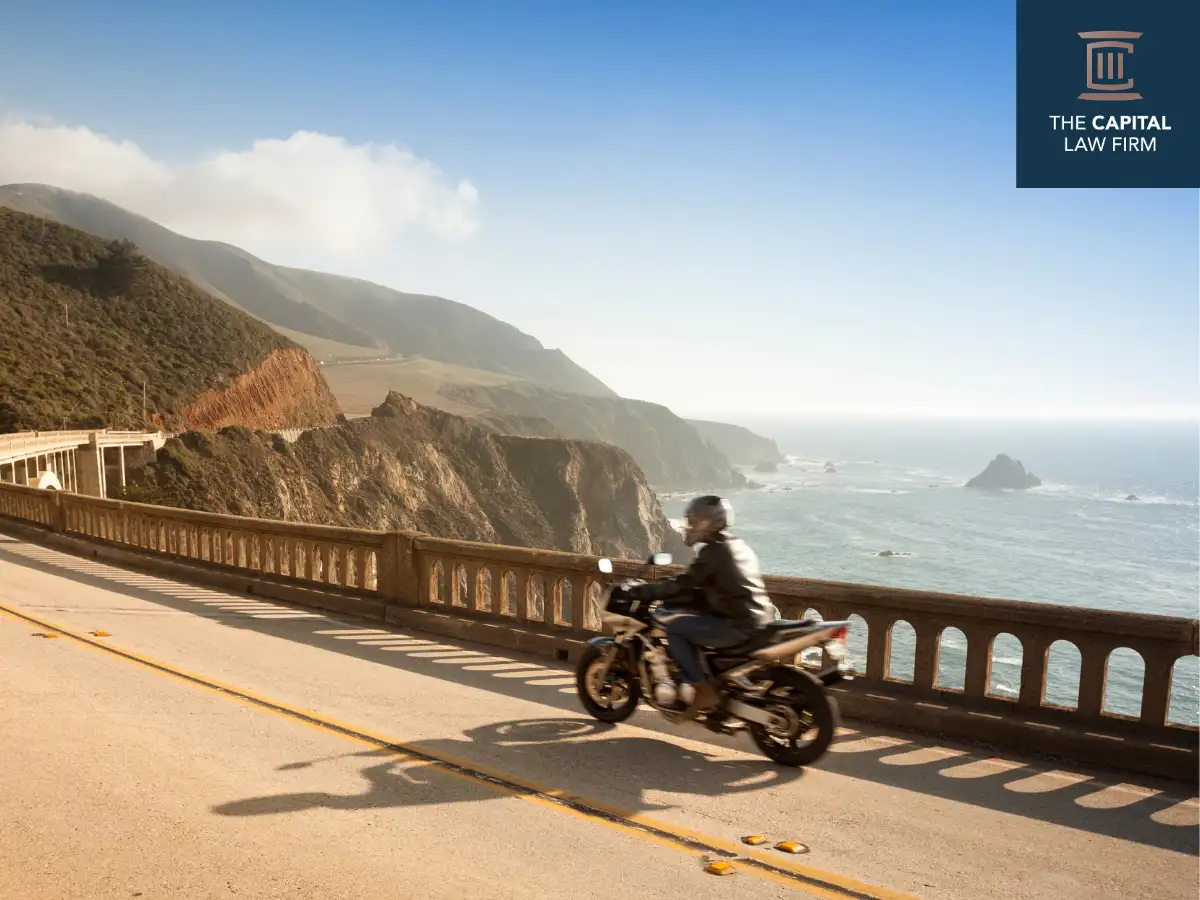
Riding a motorcycle provides a sense of freedom like no other, especially with the beautiful highways and scenic routes our state has to offer. However, motorcyclists are uniquely vulnerable on the road. Without the structural protection of traditional motor vehicles, prioritizing motorcycle safety and following the traffic laws is crucial to prevent serious trauma.
Understanding the motorcycle laws in California is essential for protecting your physical well-being and making sure you stay in legal compliance. Whether you are a seasoned rider or just securing your learner’s permit, staying informed about the latest California motorcycle laws makes certain you can focus on the open road ahead.
At a Glance
- Helmet Laws: California’s universal helmet law requires all riders and passengers to wear DOT-compliant helmets.
- Lane Splitting: California explicitly allows lane splitting, provided it is done safely and responsibly.
- Insurance Updates: Minimum motorcycle insurance coverage limits for bodily injury significantly increased statewide as of January 1, 2025.
- Strict DUI Enforcement: The law applies to motorcyclists just as it does to car drivers, enforcing strict 0.08% BAC limits, with zero tolerance for those under 21.
Essential Safety Gear and Helmet Requirements
California has strict laws regarding motorcycle helmets to protect both the rider and their passenger. The state’s universal helmet law requires that all motorcycle operators and passengers wear a helmet securely fastened and approved by the Department of Transportation (DOT). Riding without a helmet is illegal, and violators can face fines and points on their driving record. More importantly, adhering to the safety rules and wearing a helmet drastically reduces the risk of serious head injuries in the event of a crash.
While helmets are legally mandated, California strongly recommends wearing other appropriate safety gear, such as protective jackets, gloves, and durable footwear, to help protect you in the event of an unexpected accident.
Licensing Your Ride
To legally ride a motorcycle in the state, you must understand the different motorcycle license types and obtain a valid full motorcycle license (either Class M1 or Class M2). To obtain a license, individuals must be at least 16 years of age and pass a mandatory vision test, a motorcycle knowledge test (which covers concepts different from those in a standard driver knowledge test), and a physical motorcycle skills test. All applicants must pass the written test at the California Department of Motor Vehicles based on the California Motorcycle Handbook.
If you are under the age of 21, you are also required to complete a California Motorcyclist Safety Program (CMSP) course. Completing a motorcycle rider training course or similar motorcycle safety training provides vital real-world skills. Even adults can benefit from voluntary motorcycle training.
Riders who skip a formal motorcycle training course will need to pass the riding skills test directly at the DMV. For younger riders who have already completed their driver’s education, a motorcycle instruction permit is available starting at 15 years and 6 months old.
Navigating Lane Splitting Safely
California is the only state that explicitly legalizes lane splitting for motorcycles. The California Highway Patrol (CHP) has established guidelines on lane splitting, reminding riders that it must always be done in a safe and prudent manner.
Motorcycle riders can often safely lane split when cars are stopped or moving slowly, typically in traffic moving at 30 miles per hour or less. Additionally, riders should not exceed 10 miles per hour faster than the surrounding other vehicles. If lane splitting is done recklessly or in dangerous conditions, it could lead to a citation. Motorcyclists must remain acutely aware of their surroundings and the unpredictable behavior of other drivers.
Equipment, Noise, and Passenger Laws
California law requires that all motorcycles be equipped with specific features to be legally operated on public roads. According to the California Vehicle Code, handlebars cannot be positioned more than six inches above the operator’s shoulder height. Motorcycles must also have both left and right mirrors, a working muffler, and their headlights on during both day and night for visibility. Furthermore, motorcycles manufactured after January 1, 1973, must have proper working yellow or white turn signals on the front and rear.
There are also specific laws governing alternative rides; for instance, a motorized bicycle, a motor-driven cycle, or a motorized scooter may have different road restrictions compared to a standard motorcycle or an off-highway vehicle.
As of 2025, California has implemented stricter enforcement against illegal street activities, particularly targeting street takeovers, and has updated regulations regarding motorcycle exhaust systems with stricter noise output limits. The state’s Motorcycle Anti-Tampering Act also prohibits modifications that could alter emissions, safety features, or performance in unsafe ways.
Familiarizing yourself with motorcycle passenger laws is also crucial. If you ride with a passenger, the motorcycle must be outfitted for two-person use with a securely fastened seat behind the driver. The passenger must wear a DOT-compliant helmet and be able to safely reach the footrests while the vehicle is in motion.
DUI Regulations and Insurance Requirements
Motorcyclists are subject to the same DUI laws as car drivers. Operating a motorcycle under the influence of drugs or alcohol is illegal, with a blood alcohol content (BAC) limit of 0.08%. Riders under 21 are subject to a strict zero-tolerance policy. Law enforcement uses sobriety checkpoints to catch impaired riders, and if an intoxicated motorcyclist is involved in an accident, they face severe criminal penalties and potential personal injury lawsuits.
Additionally, you must carry proof of insurance when riding. There is a common misconception that California’s minimum liability limits for 2025 are $15,000 for injury or death to one person, $30,000 for multiple people, and $5,000 for property damage. In reality, to better protect drivers and victims financially, California updated these laws on January 1, 2025, doubling the minimum required liability insurance to $30,000 per person, $60,000 per accident, and $15,000 for property damage. Failing to carry proper insurance can lead to severe penalties, including license suspension, if you are pulled over or involved in a crash.
Frequently Asked Questions
Q: Can a passenger file a claim if they are injured in a crash?
A: If a passenger is injured in a crash, they may have the right to file an insurance claim or personal injury lawsuit to seek compensation for their injuries.
Q: Does California set a strict minimum age for motorcycle passengers?
A: California does not set a strict minimum age for motorcycle passengers, but the law does require that they must be able to reach the footrests safely.
Q: What should I do if a negligent driver causes my motorcycle accident?
A: Your health is the priority. Seek medical attention immediately, gather information at the scene if you are physically able, and consult with an experienced attorney before speaking to the driver’s insurance adjuster.
Injured on the Open Road? You Don’t Have to Ride This Out Alone.
Healing from a motorcycle crash is a painful, frightening, and overwhelming journey. Between the severe physical pain, mounting medical bills, and lost income from missing work, you may feel burdened by the aftermath of an accident that wasn’t your fault. We know how difficult this time is, and you shouldn’t have to face the aggressive tactics of insurance companies alone.
At The Capital Law Firm, P.C., When We Fight For You, It’s Personal. As your dedicated Los Angeles motorcycle accident attorneys, we are client-first, trial-ready advocates heavily invested in your recovery. Our personal injury law firm in Los Angeles maintains a client-forward customer service approach: Once you become a client, you will always be able to speak directly to an attorney about your case. We provide comprehensive support during your medical process so you can focus entirely on getting better.
Let a trusted Los Angeles motorcycle accident law firm carry the legal weight for you. Contact us today at (213) 814-1020 or complete our online form to schedule a free, confidential consultation. Our team is available 24/7 to help you move forward with strength, clarity, and support from our primary office at 6420 Wilshire Blvd, 18th Floor, Los Angeles, CA 90048.
Copyright © 2026. The Capital Law Firm, P.C. All rights reserved.
The information in this blog post (“post”) is provided for general informational purposes only and may not reflect the current law in your jurisdiction. No information in this post should be construed as legal advice from the individual author or the law firm, nor is it intended to be a substitute for legal counsel on any subject matter. No reader of this post should act or refrain from acting based on any information included in or accessible through this post without seeking the appropriate legal or other professional advice on the particular facts and circumstances at issue from a lawyer licensed in the recipient’s state, country, or other appropriate licensing jurisdiction.
The Capital Law Firm, P.C.
6420 Wilshire Blvd, 18th Floor
Los Angeles, CA 90048
(213) 814-1020
https://capfirm.com/